Showing posts with label The Joy of Children's Literature. Show all posts

Thursday, June 21, 2012

Censorship

In the Realistic Fiction Chapter of The Joy of Children's Literature textbook, there is a section about perspectives on censorship.  There are many challenged and banned books.  According to the text book, a challenge is "an attempt by an individual or group to remove or restrict materials from the curriculum or library based upon objectionable ideas and information."  Parents and schools can challenge books.  Books are frequently challenged due to sexual content, offensive language, suitability for the intended age group, violence, and homosexuality.  The school board can either deny the challenge or ban the material by having it removed from classrooms and schools.  Often times, banning books does not achieve its goal.  Censored books sometimes become best sellers.  This happens due to the highly publicized challenge.  Students are sometimes drawn more to books that are objected by adults and find ways around the censors.  Teachers and librarians can help to reduce censorship by being aware of issues that might cause a challenge and a ban.  It is important for teachers and librarians to evaluate and check books for challenging issues.  Below is a list of the top 15 banned/challenged books and a website to the American Library Association's web page about banned and challenged books.


Top 15 banned/challenged books:
  • Harry Potter Series - J.K. Rowling
  • Alice Series - Phyllis Reynolds Naylor
  • The Chocolate War - Robert Cromier
  • And Tango Makes Three - Justin Richardson/PeterParnell
  •  Of Mice and Men - John Steinbeck
  • I Know Why the Caged Bird Sings - Maya Angelou
  • Scary Stories Series - Alvin Schwartz
  • His Dark Materials Series - Philip Pullman
  • The Perks of Being a Wallflower - Stephen Chbosky
  • Fallen Angels - Walter Dean Meyers
  • It's Perfectly Normal - Robie Harris
  • Captain Underpants Series - Dav Pilkey
  • The Adventures of Huckleberry Finn - Mark Twain
  • The Bluest Eye - Toni Morrison
  • Forever - Judy Blume
ALA Banned and Challenged Books: http://www.ala.org/advocacy/banned

Tuesday, June 19, 2012

Non-Fiction and Informational Texts

In The Joy of Children's Literature, Chapter 10 is about Non-Fiction texts.  I was interested in this chapter because I recently read an article about non-fiction and informational texts.  The article is titled "Fiction vs. Informational Texts: Which Will Kindergarteners Choose?", and it is written by Marlene Ponte Correia.  The article is about a study that was done among a class of Kindergarteners.  The study was to determine whether Kindergarten students will pick fiction or nonfiction texts more often. It was over a period of 19 weeks.  The study showed that Kindergarteners pick nonfiction books just as often, or even more often, than fiction books.  The teacher found that students liked to learn about things they found interesting.  The children chose nonfiction or informational texts over fiction 14 out of the 19 weeks!  I found this article interesting because I thought, just like the teacher in the article, that young students would choose fiction books. It was a very informative and interesting article to read.  Everyone should read this article to find out more about nonfiction books and why students like to read them.

http://www.naeyc.org/files/yc/file/201111/Correia_Fiction_vs_Informational_Texts_Online%201111.pdf


Friday, June 15, 2012

Realistic Fiction

Chapter 7 of The Joy of Children's Literature is about Realistic Fiction.  This genre is fiction based on realistic events.  It is considered realistic because the books involve setting, characters, and events that are plausible.  However, these books are fiction because the realistic events or characters are not real and did not really happen.  Authors do in fact base much realistic fiction on their own lives, though.  There are seven categories of realistic fiction.  The categories are survival/adventure, mystery, humor, animals, sports, family, and growing up.  Survival and adventure realistic fiction has a fast-paced plot with a conflict between person and nature.  Mystery has suspense, action, and a logical solution that is foreshadowed through clues in the book. Humor has characters that are involved in funny situations. Animal realistic fiction is about the affect that a relationship with an animal has on a character.  Books in the sports category focus on thrills that accompany a particular sport.  Realistic fiction about family are about the strong need for family to overcome conflict.  Books about growing up are about characters growing more independent.  Here are some examples of books in these categories.

Survival/Adventure - Hatchet by Gary Paulsen
Mystery - The Egypt Game by Zilpha Keatley Snyder
Humor - Ramona by Beverly Cleary
Animals - Because of Winn-Dixie by Kate DiCamillo
Sports - Free Baseball by Sue Corbett
Family - Yolanda's Genius by Carol Fenner
Growing Up - Criss Cross by Lynne Perkins

Reference: 
Johnson, Denise. The Joy of Children's Literature. Second Edition ed. Belmont, CA: Wadsworth Cengage Learning, 2012. Print.

Thursday, June 14, 2012

Making the Connection Across the Curriculum

In chapter 4 of The Joys of Literature, there is a section titled "Making the Connection Across the Curriculum."  This section is about how fiction and nonfiction picture books can be used to provide information that relates to content area for many grade levels.  Poetry, alphabet books, and pop-up books can also provide content area related information. 

Four common core subjects that can be seen in picture books are math, science, art, and history.  Math can be seen through picture books that present concepts such as probability, symmetry, and numbers.  Science picture books can be about philosophers, nature, animals, etc.  Art can be seen through almost all picture books by explaining illustrations.  History picture books can relate past events to present events.

I have listed a few examples of picture books related to content area below.
  • G is for Googol by David Schwartz 
  • A Remainder of One by Elinor J. Pinczes
  • Math Curse by Jon Scieszka
  • Starry Messenger by Peter Sis
  • Science Verse by Jon Scieszka
  • Ubiquitous: Celebrating Nature's Survivors by Joyce Sidman
  • M is for Music by Kathryn Krull
  • Lives of the Artists: Masterpieces, Messes (and What Neighbors Thought) by Kathryn Krull
  • Leonardo's Studio: A Pop-Up Experience by Bob Hersey
  • Van Gogh's House: A Pop-Up Experience by Bob Hersey
  • A Walk in Monet's Garden: A Pop-Up Book by Francesca Crespi
  • Barefoot: Escape on the Underground Railroad by Pamela Edwards
  • A Good Night for Freedom by Barbara Morrow
  • Liberty Street by Candice Ransom
  • Harriet Tubman: Conductor of the Underground Railroad by Ann Petry
  • The Underground Railroad by Raymond Bial
  • Remember the Bridge: Poems of a People by Carole Weatherford


Reference: 
Johnson, Denise. The Joy of Children's Literature. Second Edition ed. Belmont, CA: Wadsworth Cengage Learning, 2012. Print.

Wednesday, June 13, 2012

Reading Aloud

Chapter 13 in The Joys of Literature is called "Reading to and with Children: Reading Aloud, Shared and Guided Reading and Writing."  One section in the chapter is all about reading aloud to children.  Reading aloud is a memory that children carry with them for years.  It builds an enthusiasm for reading in the children.  I love reading aloud to students as well as having others read to me.  When I was an elementary student my favorite part of the day was when my teachers would read aloud to the class.  I especially loved being read chapter books.  It was always so exciting wondering what was going to happen in the book the next day.

 The chapter focuses on when and what to read aloud to students.  The Joys of Literature states that it "depends on students' strengths and needs and curricular goals."  There should also be a time of day to read aloud just for fun.  When deciding what to read aloud, it is important to read a range of different books according to the developmental needs of students. It is also important to choose books that will interest students.

Some of the benefits of reading aloud:
  • increased motivation for reading
  • vocabulary development
  • reading comprehension
  • literacy understanding

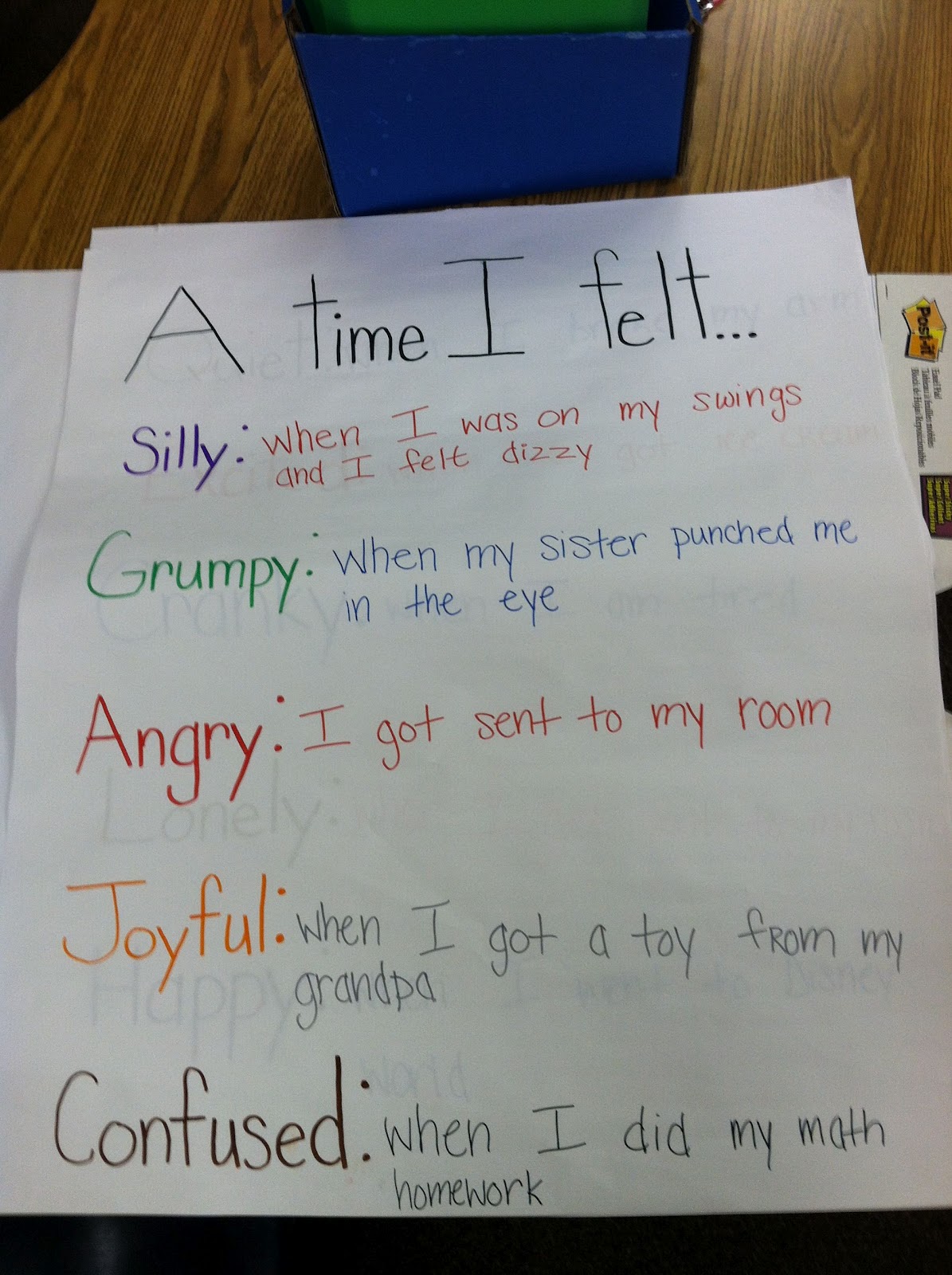
This is a picture of a read aloud I did in a 1st grade classroom last year.  I read Today I Feel Silly by Jamie Lee Curtis.  After reading, we did an activity about times when the students felt different ways.


Reference: 
Johnson, Denise. The Joy of Children's Literature. Second Edition ed. Belmont, CA: Wadsworth Cengage Learning, 2012. Print.